From Ambition to Delivery: What Canada-UK Nuclear Day 2026 Revealed About the Workforce Behind the Partnership
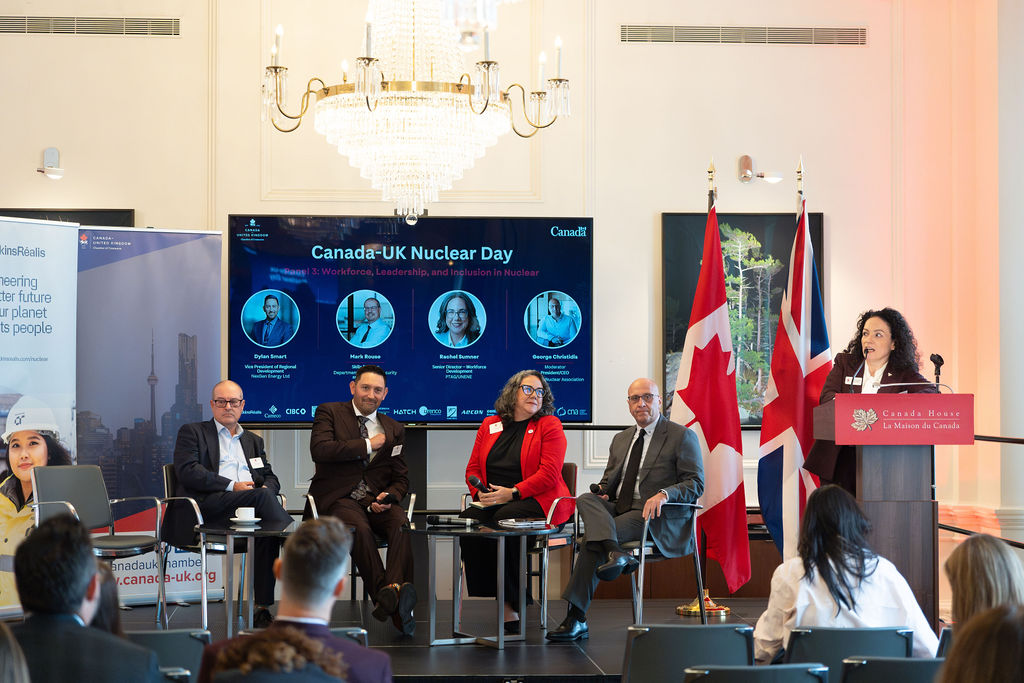
On September 8, 2026, delegates from across the nuclear sector gathered at Canada House in London for Canada-UK Nuclear Day 2026, hosted by the Canada-UK Chamber of Commerce under the theme “From Ambition to Delivery: Building the Canada-UK Nuclear Partnership.” Ministers, utility executives, financiers, and fusion pioneers spent the afternoon walking through fuel supply chains, SMR deployment schedules, financing structures, and next-generation technology roadmaps. But underneath nearly every panel sat the same unresolved question: who is actually going to build all of this, and how do we get them ready in time?
That question is the one PTAG’s Workforce Development Practice was built to answer. What follows is a look at what was said in London, and where the Practice’s strategy already lines up with the gaps the day surfaced.
The Delivery Question Has a Workforce Answer
The day’s first panel, on delivering advanced nuclear technologies from SMRs to deployment, opened with a blunt framing from moderator Jandre Bezuidenhout, Director at Hatch Associates: the industry has largely proven it can design, license, and finance new reactors. “The question now shifts to a delivery question,” he told delegates, “which really is about: can we deliver on the promise? Can we build power plants that are repeatable, that can be delivered on schedule?”
Ontario Power Generation’s Geoff Olynyk, Director of Strategy and Business Development, pointed to just how long that promise takes to keep. Reflecting on OPG’s build-out plans, he noted that some of the reactors now on the drawing board “won’t be online until 2050..the people constructing that reactor, it’s for the next 23 years, and then they’ll be operating it for a lot longer after that.” OPG’s own talent pipeline has had to stretch to match: partnerships that used to start at trade schools and universities now reach into high schools and, in one case, elementary school classrooms. Olynyk also flagged a problem PTAG hears constantly from clients, which is the persistent friction moving skilled trades across provincial and state lines. “There’s still friction having skilled workers across provinces, union friction or regulatory friction,” he said. “We need to start doing this nationally.”
GE Vernova Hitachi’s Country Director, Andrew Champ, put the sharper edge on it: the industry is at risk of competing with itself for the same small pool of experienced people. “If we all just fight for the same number of staff, we’re all going to be outbidding, increasing the cost to all our projects, and putting all our own projects at risk,” he told the panel, calling for coordinated workforce development that starts “even before you need the individuals,” because nuclear-grade experience takes years to build. It’s a dynamic the four-party Darlington SMR team (OPG, AtkinsRéalis, GE Vernova Hitachi, and Aecon Nuclear) has tried to design around from day one, right down to a shared “SMRX” identity on site gear instead of four separate company logos. As Aecon Nuclear’s Greg Thede and AtkinsRéalis’s Mike Reynolds, Managing Director for Nuclear EMEA, described it, the point is that “the costs are shared, the benefits are shared, the rewards are shared” which is a model that treats workforce capacity as a shared asset rather than a competitive one.
Equity Has to Come Before Ownership
The day opened with keynote remarks from Canada’s High Commissioner to the UK, H.E. Bill Blair, and the UK’s Minister of State for Energy, Michael Shanks MP, before the panel that followed brought together Saskatchewan Premier Scott Moe, Cameco UK’s Executive Vice-President and CFO Grant Isaac, and Sheldon M. Wuttunee, CEO and President of the Saskatchewan First Nation Natural Resource Center of Excellence (SFNNRCE). Between them, they made the case that none of the delivery capacity discussed all day is possible without genuine Indigenous partnership and that partnership has to be built long before contracts are signed.
Isaac was direct about what that partnership requires. Cameco works through what he described as a sequence of four pillars; workforce development, business development, community development, and capacity building, with equity conversations coming only after, never instead of, that groundwork. “It’s not like we’re a partner because we’re willing to invest,” he said. “It’s not a transaction… if you’re willing to be a shareholder, we’ll be a partner. It’s got to be deeper than that. That’s not a real partnership.” The results, he noted, speak for themselves: roughly half of Cameco’s employees in northern Saskatchewan are Indigenous or of Indigenous ancestry, making Cameco Canada’s largest industrial employer of Indigenous people, with about 80% of goods and services for its northern operations sourced from northern, largely Indigenous-owned, businesses.
Premier Moe framed the shift in ambition simply: “Fifteen years ago, that was about a job. Today, it’s actually about the wealth of the community.” Wuttunee added that Indigenous communities across Saskatchewan are now asking how they become owners in major energy and nuclear projects, not just participants in them, which is a conversation PTAG’s Workforce Development Practice is built to support through community-designed partnership models, not template land-acknowledgment language bolted onto a project plan after the fact.
Fusion’s Talent Problem Is a Different Shape
If fission’s workforce challenge is about scale and speed, fusion’s is about invention. The panel on building the fusion economy, moderated by AtkinsRéalis’s Jannet Shimell and featuring the UK Atomic Energy Authority’s Stephen Wheeler, General Fusion’s Myles Hildebrand, the Fusion Industry Association’s Tristram Denton, and Kinectrics’ Nisa Halsey made clear that fusion isn’t just fission’s smaller, newer cousin when it comes to people.
Denton, the Fusion Industry Association’s UK Director, opened with urgency: fusion, he said, is “absolutely going to be commercially operational within 20 years… if we miss it, we will regret it for many decades to come.” Halsey, VP of Nuclear Equipment & Tooling at Kinectrics, pointed to Canada’s underused advantage here, that of a fission workforce with deep, transferable expertise. “There’s just nowhere else that has that depth of knowledge and skilled workforce, kind of ready to go,” she said, arguing the goal should be workers “who have the foundations down… so that they can move into the next set of challenges, which is usually the supply chain.”
That transferability, though, is exactly what Denton returned to when he put the sharpest question of the session to the panel: as fusion emerges as a genuinely competing career path, how does the industry attract the workers it needs without simply pulling them out of fission, in other words competing for the same finite, hard-won talent pool the fission sector has spent decades building? It’s the mirror image of the concern GE Vernova Hitachi’s Andrew Champ had raised earlier in the day about fission companies outbidding each other, except fusion doesn’t yet have fission’s scale of established roles, credentials, or career ladders to offer in return.
Myles Hildebrand’s own remarks pointed to part of the answer, and part of the difficulty. Describing General Fusion’s engineering approach to magnetized target fusion, he painted a picture of an industry still writing its own rulebook, which raises the question of how you attract people who “don’t need the book” in the first place: engineers and technicians comfortable building toward a target that hasn’t been standardized yet, rather than following an established playbook the way a fission technician can. That is a fundamentally different recruiting and credentialing challenge than fission’s, and one existing nuclear training pathways aren’t yet built to solve.
Stephen Wheeler’s contribution, as Executive Director overseeing the UK Atomic Energy Authority’s fusion technology and fuel cycle divisions, cut into a related, less obvious barrier: how the sector structures the deals that are supposed to move fusion technology and people forward together. Wheeler raised the point that intellectual property is often far more tangible to the lawyers structuring UK-Canada fusion partnerships than the human capability sitting behind it, such as the trained people, tacit know-how, and institutional experience that make a tritium loop facility or a fuel-cycle partnership actually work. His question for delegates: how do you construct commercial deals and government-to-government agreements that value both the IP and the capability behind it, rather than treating workforce capacity as an afterthought to the licence terms? It’s a question PTAG’s Workforce Development Practice takes seriously in every capital project it supports. A partnership agreement that protects a patent but doesn’t plan for who operates and improves on it isn’t finished.
Where the Risk Really Sits
The day’s fireside conversation on financing new nuclear build which covered regulated asset base (RAB) models and institutional investment, moderated by RBC’s Ralph Ibendahl, produced the line that, for our Practice, tied the whole day together. Declan Burke, Nuclear Power Strategy Director at Centrica Energy, speaking alongside Bruce Power’s Pat Dalzell on how these deals get structured, made the case that risk has to sit with whoever is best placed to manage it: capital risk with investors who can price and hedge it, construction risk with the delivery partners who control schedule and cost, and so on. It’s a foundational principle of project finance and, as our own Rachel Sumner argued from the workforce panel later that afternoon, one the nuclear sector still isn’t applying to the people it needs to hire.
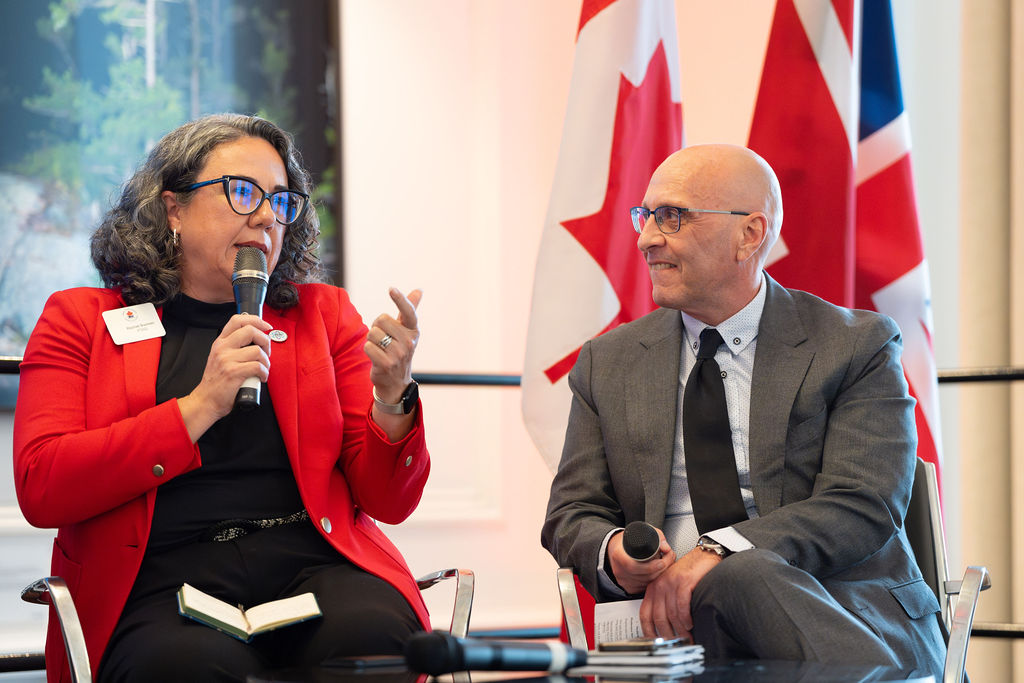
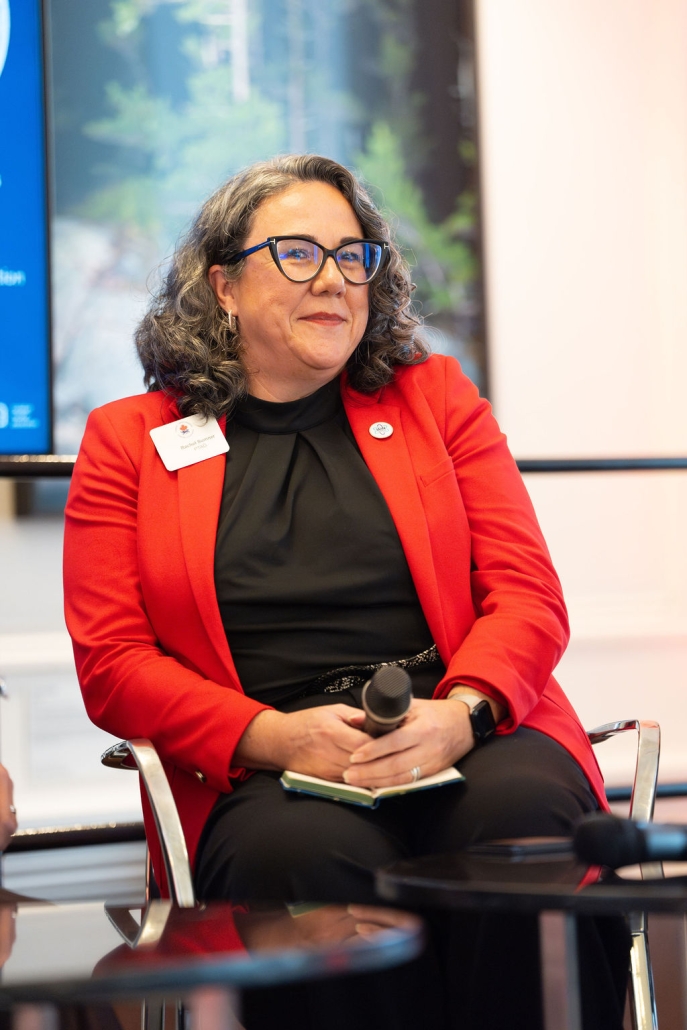
As Practice Lead and Senior Director of PTAG’s Workforce Development Practice, Rachel picked up Burke’s framing directly. “We are expecting the individual worker to bear too much of the risk right now,” she told delegates. “We’re expecting them to find the signal in the noise about where the opportunity lives, follow that signal, maybe personally self-fund their own training, and take a bet that the opportunity will actually be there at the end of it. Our governments are investing in skilled trades, and that’s great to see, but there are so many other roles across nuclear where that risk is still sitting entirely with the individual. If that investment doesn’t reach the people we’re trying to attract into this industry, and help them manage that risk, we’re going to struggle to bring them in. I’d love to see more innovation in how we help an individual Canadian, or an individual Brit, manage the risk of joining an industry like ours.”
Rachel’s point isn’t that governments and industry aren’t investing. The skilled trades commitments on both sides of the Atlantic are real, and welcome. It’s that those investments shift some of the risk off individuals without necessarily shifting enough of it, particularly for the roles that fall outside the trades: engineers, technicians, and specialists weighing a career bet against genuine project uncertainty and, as of today, no clear, sector-wide demand signal telling them the opportunity will still be there in five years. Until financing risk, delivery risk, and workforce risk are all deliberately placed with the party best able to manage each one (governments, employers, and individuals alike) the sector will keep asking prospective workers to shoulder a bet that project sponsors and financiers would never accept themselves.
PTAG’s Response
This is precisely the gap PTAG’s Workforce Development Practice was built to close, and Canada-UK Nuclear Day 2026 mapped almost exactly onto how we structure that work:
Mobility. Geoffrey Olynyk’s interprovincial trade friction, and the UK’s own regional skills constraints, are workforce mobility problems we design around directly. We build the credential-recognition and deployment pathways that let skilled people move to where projects actually are.
Attraction and retention. From Andrew Champ’s competition-for-staff warning to Tristram Denton’s fusion-versus-fission question and Myles Hildebrand’s “don’t need the book” recruiting challenge, the day made clear that attraction strategy can no longer treat “nuclear talent” as one pool. Fission, fusion, and the trades each need distinct value propositions, credentialing pathways, and career narratives. And, per Rachel’s point, a genuine reduction in the personal risk of signing on.
Expanding the talent pool through Indigenous partnership. Grant Isaac’s four-pillar sequencing and Sheldon Wuttunee’s push toward Indigenous ownership are the model. We need partnership built on workforce and community development first, with equity as the outcome of trust rather than a substitute for it.
Education and skills alignment. Mark Rouse, Skills Director for the Nuclear Sector Skills Team at the UK’s Nuclear Decommissioning Authority (NDA), told the workforce panel that an estimated 80% of the skills nuclear needs are generic and transferable from sectors like rail and aviation, with only roughly 20% being true nuclear specialists. That statistic alone should reshape how both countries build training pipelines: less about building nuclear-only programs from scratch, and more about designing clear on-ramps from adjacent industries, which is exactly where PTAG’s role and capability architecture work starts.
Underneath all four pillars sits the point Declan Burke and Rachel both raised: none of this works if the risk of getting there still rests almost entirely on the individual worker.
The Partnership Is Real. So Is the Deadline.
The Canadian Nuclear Association estimates a workforce gap of roughly 7,500 to 8,000 skilled positions by 2030 as retirements accelerate. This is a figure that lines up closely with PTAG’s own analysis showing that over 25% of Canada’s nuclear workforce reaches retirement age by the early 2030s, against 22.3 GW of new capacity now planned across four provinces. On the UK side, modelling shared with the workforce panel shows female representation in the nuclear workforce stuck at 22%, with existing diversity efforts only projected to move that to roughly 30% over the next five to ten years. One delegate called this a genuine blind spot in an industry that cannot afford to leave half its potential talent pool underused.
Canada-UK Nuclear Day 2026, moderated in its closing workforce panel by Canadian Nuclear Association President and CEO George Christidis, showed a partnership that has moved well past ambition on fuel supply, technology, and financing. The workforce conversation is catching up, but as Tristram Denton, Myles Hildebrand, Stephen Wheeler, Declan Burke, and Rachel all pointed out from different corners of the same day, catching up means designing deliberately for who does the work, not assuming the people will simply appear once the contracts are signed.
Work With Us
PTAG’s Workforce Development Practice works at the intersection of workforce strategy, project execution, and stakeholder engagement which enables days like this one to inform site-level and program-level plans. Rachel Sumner leads the Practice as Senior Director and also serves as Chair of the Canadian Nuclear Association’s National Workforce Council and as a Senior Advisor on Workforce Initiatives with the University Network of Excellence in Nuclear Engineering (UNENE). These are roles that keep the Practice directly connected to how Canada’s nuclear workforce strategy is actually being written.
If your organization is planning nuclear capacity and needs a workforce strategy that matches the ambition of the projects themselves, from Indigenous partnership design to workforce mobility to closing the fission-fusion talent gap, connect with Rachel and the Workforce Development Practice team.