PTAG Advisor and Ontario Tech University Professor Akira Tokuhiro recently joined Tobias Bieker for an interview on Unpacking Japan, recorded in Osaka in late May 2026.
The conversation explores project and infrastructure delivery through the perspective of an experienced engineer, educator, and advisor. Drawing on his international background and academic leadership, Akira brings a valuable perspective to the complex challenges that shape major capital projects.
In the interview, Akira discusses the current and future role of nuclear power as a clean energy source, Japan’s response to Fukushima, and the path toward net-zero carbon emissions.
The interview reflects the type of informed, cross-disciplinary thinking required to improve project performance and build stronger delivery organizations.
Watch Akira Tokuhiro’s full interview with Tobias Bieker on Unpacking Japan:
/wp-content/uploads/2026/07/Akira-Tokuhiro-Headshot.png709945Elnaz Khaleghi/wp-content/uploads/2024/10/PTAG-Header-Logo-300x50.pngElnaz Khaleghi2026-07-27 10:59:452026-07-27 10:59:54PTAG Advisor Akira Tokuhiro Featured on Unpacking Japan
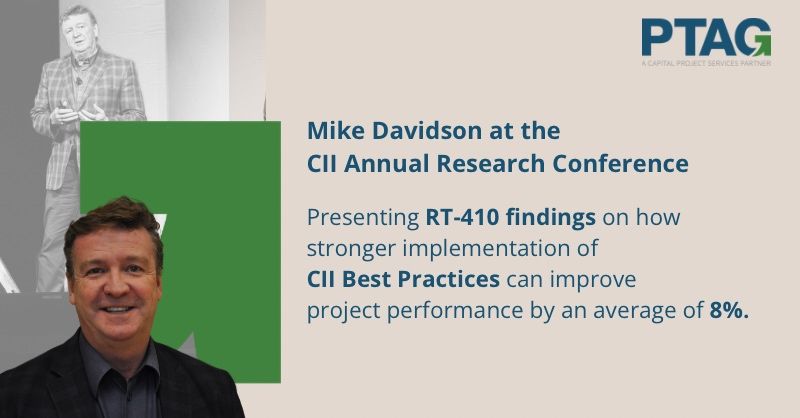
At the 2026 Construction Industry Institute Annual Research Conference, PTAG’s Mike Davidson, presented with Research Team 410 on the connection between CII Best Practice implementation and capital project performance.
The research found that projects with high implementation of CII Best Practices achieve 8% better cost performance than projects with low implementation. This makes implementation maturity a valuable leading indicator, helping owners and contractors identify likely cost outcomes before final results are known.
RT-410 reached this conclusion by benchmarking Best Practice implementation across a growing project dataset and comparing it with actual cost performance. The approach closely reflects PTAG’s benchmarking methodology: measure performance against peers, identify meaningful gaps, and focus improvement efforts where they can have the greatest impact on cost and schedule.
Congratulations to Mike and the RT-410 team on delivering research that owners and contractors can put into practice.
/wp-content/uploads/2026/07/4.jpg13652048Elnaz Khaleghi/wp-content/uploads/2024/10/PTAG-Header-Logo-300x50.pngElnaz Khaleghi2026-07-22 11:18:432026-07-27 11:21:53PTAG’s Mike Davidson Presents CII Research on Best Practice Implementation and Project Performance
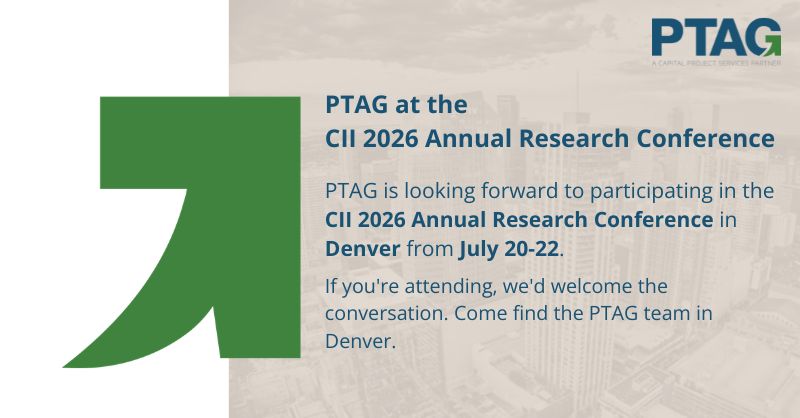
PTAG will be in Denver for the Construction Industry Institute’s 2026 Annual Research Conference, taking place July 20–22 at the Sheraton Denver Downtown Hotel.
CII’s research and best practices are embedded in the PTAG Playbook and directly inform how we support complex capital programs. At this year’s conference, our team will be engaging in discussions around Project Controls, Advanced Work Packaging, and Advanced Project Delivery across Power & Utilities, Mining & Metals, Oil & Gas, and Infrastructure.
For PTAG, this conference is more than an industry gathering. It is an opportunity to contribute to the research and ideas shaping better project delivery.
Attending the conference? Connect with the PTAG team in Denver.
/wp-content/uploads/2023/10/CII-Partner-Logo-2.png122256Elnaz Khaleghi/wp-content/uploads/2024/10/PTAG-Header-Logo-300x50.pngElnaz Khaleghi2026-07-09 11:05:022026-07-27 11:07:32PTAG Heads to CII’s 2026 Annual Research Conference
Effective project execution is critical to achieving business objectives, yet many organizations struggle with delays, cost overruns, and misaligned teams. The challenge lies not only in managing scope, schedules, and budgets but also in navigating complex stakeholder environments, regulatory requirements, and evolving market conditions.
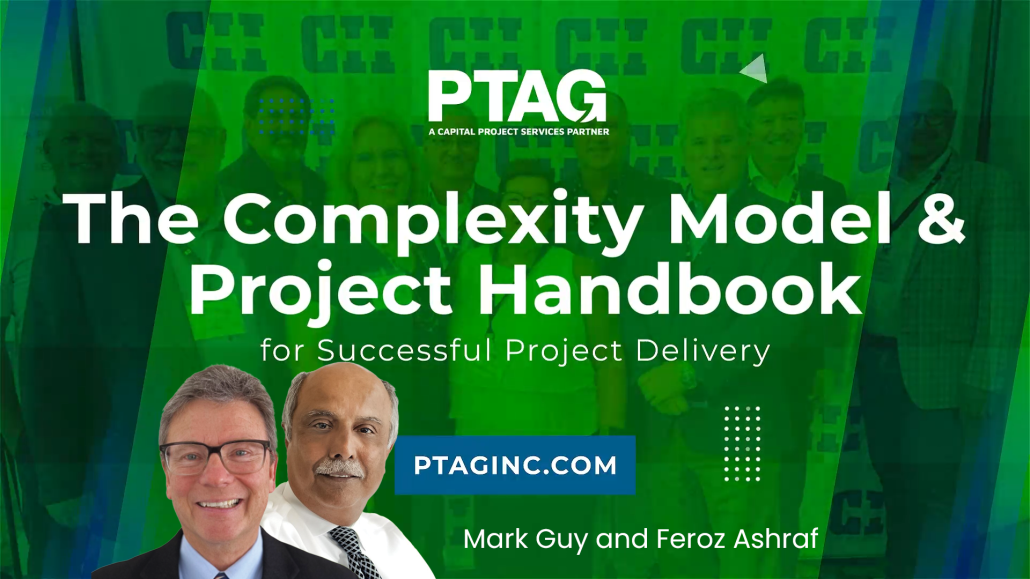
PTAG’s Complexity Model and Project Handbook provides a structured, repeatable approach to project execution that enables organizations to improve efficiency, mitigate risks, and deliver consistent results. By applying proven methodologies tailored to the unique challenges of each project, organizations can enhance performance, optimize resources, and ensure alignment across all phases of project execution.
Understanding the Core Challenges in Project Execution
Many projects fail to meet their objectives due to a combination of internal and external challenges. PTAG has identified five key factors that commonly impact project success:
Lack of Strategic Alignment: Misalignment between business objectives, project teams, and execution strategies leads to inefficiencies and costly delays.
Ineffective Stakeholder Communication: Poor coordination across departments and unclear roles create disconnects that hinder decision-making and progress.
Resource Planning Gaps: Shortages in skilled labor, supply chain disruptions, and inadequate contingency planning result in execution inefficiencies.
Unrealistic Schedules and Budgets: Overly aggressive timelines and underestimated costs increase the likelihood of overruns and rework.
Regulatory and Risk Management Challenges: Non-compliance, safety risks, and unforeseen project complexities can introduce significant financial and operational risks.
Addressing these challenges requires a structured approach that ensures clear governance, proactive risk mitigation, and cross-functional collaboration.
PTAG’s 10-Step Approach to Optimized Project Delivery
PTAG’s structured execution model is built around 10 key steps designed to streamline project management, improve decision-making, and enhance predictability.
1️⃣ Assess Market and Business Cycles – Evaluate external factors that may influence project viability and execution.
2️⃣ Define Success Criteria – Establish clear, measurable KPIs to align all stakeholders.
3️⃣ Evaluate Project Complexity – Categorize projects based on their complexity to apply the appropriate level of governance.
4️⃣ Develop a Detailed Execution Plan – Define key activities across engineering, procurement, and construction to ensure alignment.
5️⃣ Leverage Best Practices and Lessons Learned – Apply insights from past projects to drive efficiency and risk reduction.
6️⃣ Optimize Value Engineering – Identify cost-effective alternatives without compromising quality or performance.
7️⃣ Strengthen Risk Management – Implement a proactive risk management framework to mitigate potential disruptions.
8️⃣ Ensure Integrated Project Management – Foster collaboration between engineering, procurement, and construction teams.
9️⃣ Enhance Stakeholder Communication – Establish structured communication channels to improve transparency and decision-making.
🔟 Align the Project Team – Ensure all team members are working toward shared objectives with clearly defined roles and responsibilities.
This methodology enables organizations to take a structured, data-driven approach to project execution, reducing uncertainty and improving overall performance.
PTAG’s Complexity Model and Project Handbook: A Tailored Approach to Execution
One of the most common challenges in project management is applying a one-size-fits-all approach to projects with vastly different levels of complexity. PTAG’s Complexity Model and Project Handbook solves this issue by:
✅ Classifying projects by complexity levels (C1 to C4) to ensure appropriate governance and oversight.
✅ Providing tailored execution strategies that match project complexity and risk profile.
✅ Integrating with project management systems for seamless implementation and adoption.
The Project Handbook is a practical, 60-70 page guide that provides a streamlined framework for execution, linking directly to best practices, tools, and methodologies. It eliminates ambiguity, ensures alignment across project teams, and drives standardization in execution.
Proven Impact: Driving Efficiency and Reducing Costs
Organizations that implement PTAG’s Complexity Model and Project Handbook experience measurable improvements in project performance:
📉 5-15% reduction in project costs through optimized resource allocation and risk management.
⏳ 3-10% acceleration in project schedules by improving coordination and execution efficiency.
📈 Stronger team alignment and stakeholder engagement through structured communication and governance.
🚀 Increased predictability in project outcomes by applying a standardized, repeatable execution approach.
By eliminating inefficiencies, reducing uncertainty, and improving decision-making, organizations can significantly enhance project success rates.
Achieve Greater Project Success with PTAG
Effective project execution requires a disciplined approach, clear governance, and alignment across teams. PTAG’s Complexity Model and Project Handbook provide a structured, proven framework for navigating the complexities of project delivery while optimizing performance and reducing risks.
If your organization is looking to improve project outcomes, reduce costs, and accelerate execution timelines, PTAG can help. Contact us today to explore how our structured execution approach can be tailored to your organization’s needs.
/wp-content/uploads/2025/02/mark-feroz-banner-2.png6971920Jess Beltran/wp-content/uploads/2024/10/PTAG-Header-Logo-300x50.pngJess Beltran2025-02-07 21:00:012025-02-07 21:00:31Enhancing Project Delivery Through Structured Execution and Complexity Management
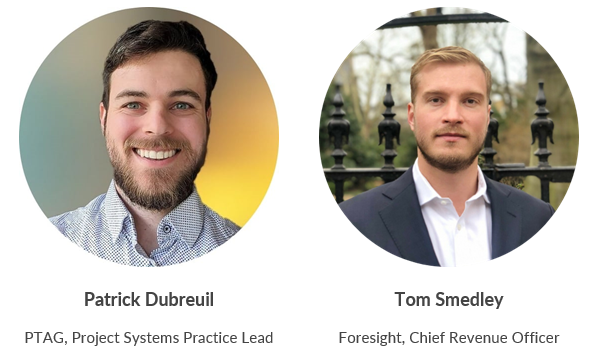
During this webinar hosted by Tom Smedley (Foresight) and Patrick Dubreuil (PTAG), participants explored how AI, machine learning, and natural language processing can revolutionize construction project management. The session, focused on addressing common challenges like delays and cost overruns, was held on April 25, 2024, drawing a diverse audience of industry professionals eager to leverage technology for better outcomes.
PTAG leverages AI tools by blending it with our deep expertise in project controls and project management, ensuring a secure project context-centric approach to handling project complexities. By integrating the benefits of AI with the contextual expertise the PTAG team brings, enhances decision-making through predictive analytics and performance insights. This combination leads to improved project delivery by enhancing schedule adherence and optimizing resource allocation. By focusing on client-specific needs and outcomes, PTAG ensures that tools like Foresight not only support but also drive superior project performance and efficiency. This strategic combination underscores PTAG’s commitment to innovation and excellence in project management.
This is the recap video recording of the webinar, which was originally recorded on April 25, 2024
Stay tuned for future webinars and industry updates from PTAG!
/wp-content/uploads/2024/04/Untitled-design-2024-04-10T103154.815-1.png22504612Elnaz Khaleghi/wp-content/uploads/2024/10/PTAG-Header-Logo-300x50.pngElnaz Khaleghi2024-05-02 13:10:572024-05-02 13:10:57Foresight and PTAG Webinar recap : Accelerate your major construction project delivery with AI – April 25, 2024
See a demo of how AI can help you execute projects faster
If your construction teams are suffering from delays and cost overruns on major projects, there is a solution. By applying AI, machine learning and natural language processing to project schedule data, you can unleash predictive insights about delay risks and work prioritization.
Join Foresight and PTAG on April 25,2024 at 11 am (EST) as we discuss best practices for how AI can improve your planning, execution, and risk recognition.
We’ll demonstrate how unlock the hidden value in your Oracle Primavera P6 and Microsoft Project data, including how to:
· Identify Priorities and Set Action Plans
· Collaborate with Diverse Stakeholders
· Recognize Risks and Bottlenecks
· Learn from Past Projects
· Enhance Schedule Reporting and Visibility
Attendees are eligible for a complimentary AI-enabled schedule health check!
See for yourself how quick and easy it is to overcome the shortcomings of legacy scheduling software.
/wp-content/uploads/2024/04/Untitled-design-2024-04-10T103154.815-1.png22504612Elnaz Khaleghi/wp-content/uploads/2024/10/PTAG-Header-Logo-300x50.pngElnaz Khaleghi2024-04-11 11:42:272024-04-11 11:42:27Best Practices Webinar: Accelerate your Major Construction Project Delivery with AI
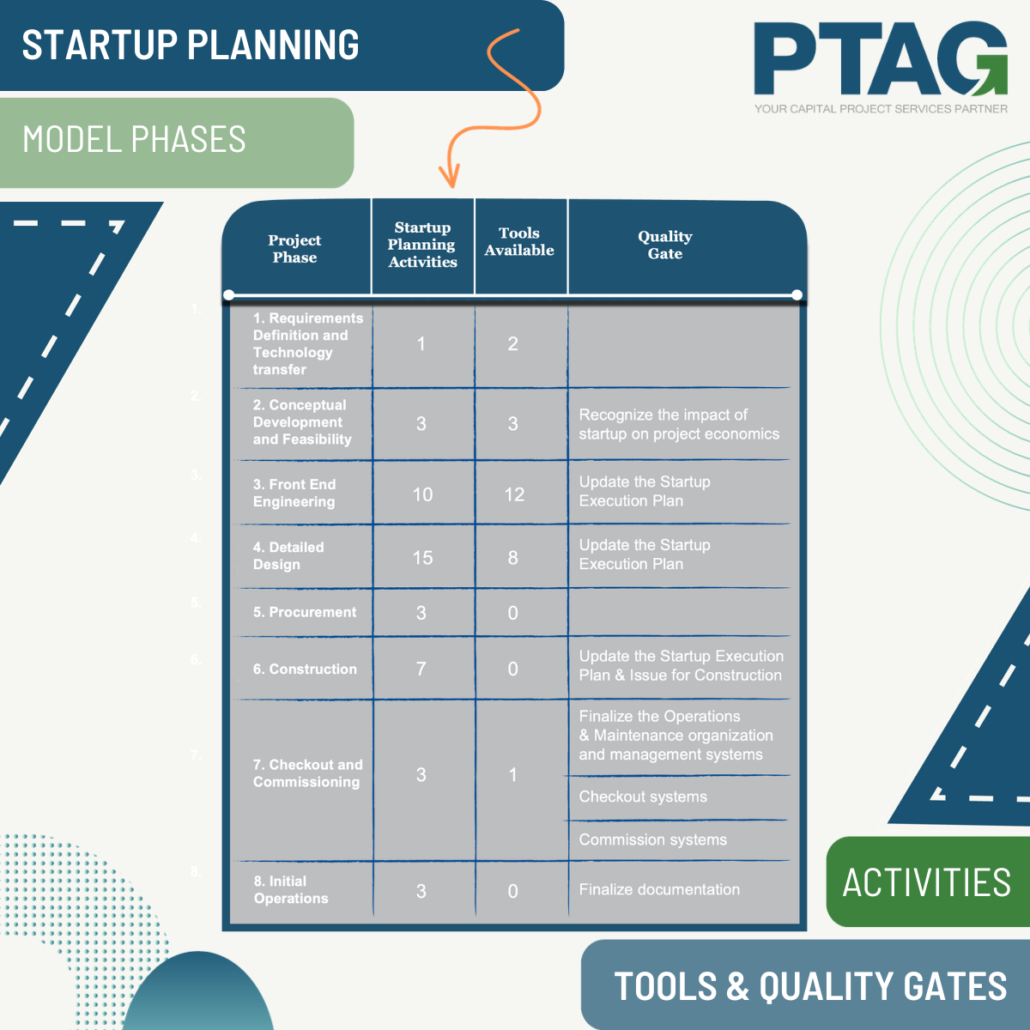
Startup is the transitional phase between plant construction completion and commercial operations, including all the activities that bridge these two phases. Critical steps within Startup include system turnover, checkout of systems, commissioning of systems, introduction of feedstock, and performance testing.
The importance of Startup planning is exemplified by the pressures to increase profits by reducing costs, reductions in owner staff and increases in outsourcing of services, demands for shorter project life-cycle times, and a lack of planning capabilities and supportive tools. These business and project challenges demand increases in organizational efficiency and management effectiveness.
Successful project delivery and commercial operation requires a successful Startup. Research indicates a reasonably strong correlation between Startup success and comprehensive Startup planning.
PTAG provides a Startup Planning Model for Startup activities through all eight project phases:
Requirements Definition and Technology Transfer
Conceptual Development and Feasibility
Front-End Engineering
Detailed Design
Procurement
Construction
Checkout & Commissioning
Initial Operations
/wp-content/uploads/2022/10/Best-Practice-2-1.png5951196Elnaz Khaleghi/wp-content/uploads/2024/10/PTAG-Header-Logo-300x50.pngElnaz Khaleghi2024-01-04 11:05:272024-01-04 11:05:27Planning For Startup
If your construction teams are suffering from delays and cost overruns on major projects, there is a solution. By applying AI, machine learning and natural language processing to project schedule data, you can unleash predictive insights about delay risks and schedule compression opportunities.
Join Foresight’s Atif Ansar and PTAG’s Michael Dubreuil subject matter experts on November 16th, 2023, at 2 pm EDT as they demonstrate how to unlock the hidden value in your Oracle Primavera P6 and Microsoft Project data.
Dr Atif Ansar
Foresight Works Ltd., Executive Chairman, & Faculty, Saïd Business School, University of Oxford
Enhance schedule visibility and easily generate reports
See for yourself how quick and easy it is to overcome the shortcomings of legacy scheduling software.
And remember: by attending, you’ll eligible for a complimentary AI-enabled schedule health check.
Foresight’s ability to assess and analyze P6 data is impressive, saves us time and generates valuable insights, helping our efforts enormously with clients
/wp-content/uploads/2024/04/Untitled-design-2024-04-10T103154.815-1.png22504612Elnaz Khaleghi/wp-content/uploads/2024/10/PTAG-Header-Logo-300x50.pngElnaz Khaleghi2023-10-26 12:08:072024-10-23 11:22:15PTAG/Foresight Joint Webinar: Accelerate your Capital Project Delivery with AI
The world will increasingly rely on Small Modular Reactors (SMRs) to meet its emission reduction targets as it transitions its sources of energy generation. Compared to other generation alternatives, SMRs provide a safer, more reliable, economical, and environmentally responsible alternative for energy generation to supply industry and society.
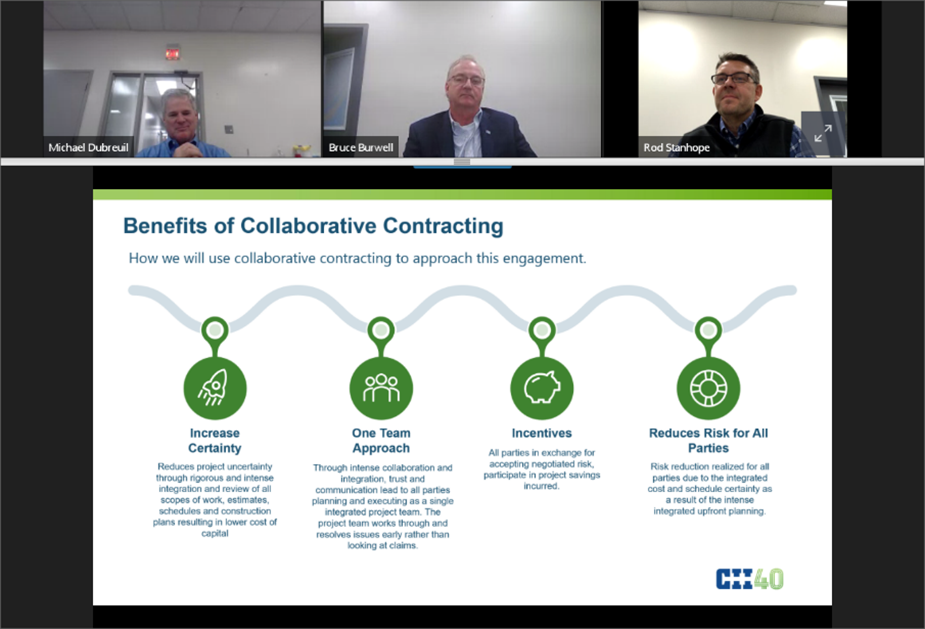
In this webinar PTAG’s Michael Dubreuil and Bruce Burwell along their CII colleagues presented an update on how Industrial IPD (I2PD) and CII Best Practices are supporting early first-mover SMR projects in both the United States and Canada with growing international interest.
The following topics were discussed in this webinar:
The projected SMR market demand
Early adopters of Industrial IPD for SMRs
What are the key features and benefits of Industrial IPD
Several CII Best Practices that will help facilitate industry readiness
For those who missed the live event or wished to revisit the valuable discussions, we have uploaded the full webinar recap video.
This is the recap video recording of the webinar, which was originally recorded on October 25, 2023
/wp-content/uploads/2023/10/CII-Partner-Logo-2.png122256Elnaz Khaleghi/wp-content/uploads/2024/10/PTAG-Header-Logo-300x50.pngElnaz Khaleghi2023-10-26 09:40:002023-10-26 09:40:00Collaborative contracting for Small Modular Reactors Webinar Recap- October 25, 2023
Modularization entails the large-scale transfer of stick-build construction effort from the jobsite to one or more local or distant fabrication shops/yards to exploit one or more strategic advantages. However, the construction industry has been slow to achieve high levels of modularization. It has reached a ceiling regarding the percentage of stick-built work hours being exported offsite. The research effort led to the development of five distinct solution elements:
Business case process
Execution plan differences
Critical success factors
Standardization strategy
Modularization maximization enablers
PTAG has industry-specific teams ready to address the question of what changes or adaptations in traditional project work processes are required to create an optimal environment for broader and more effective use of modularization. For successful modularization to occur, substantial owner involvement must occur early. The scope of research limited this team’s work to the industrial sector; however, its research findings may apply equally well to the commercial and infrastructure project sectors.
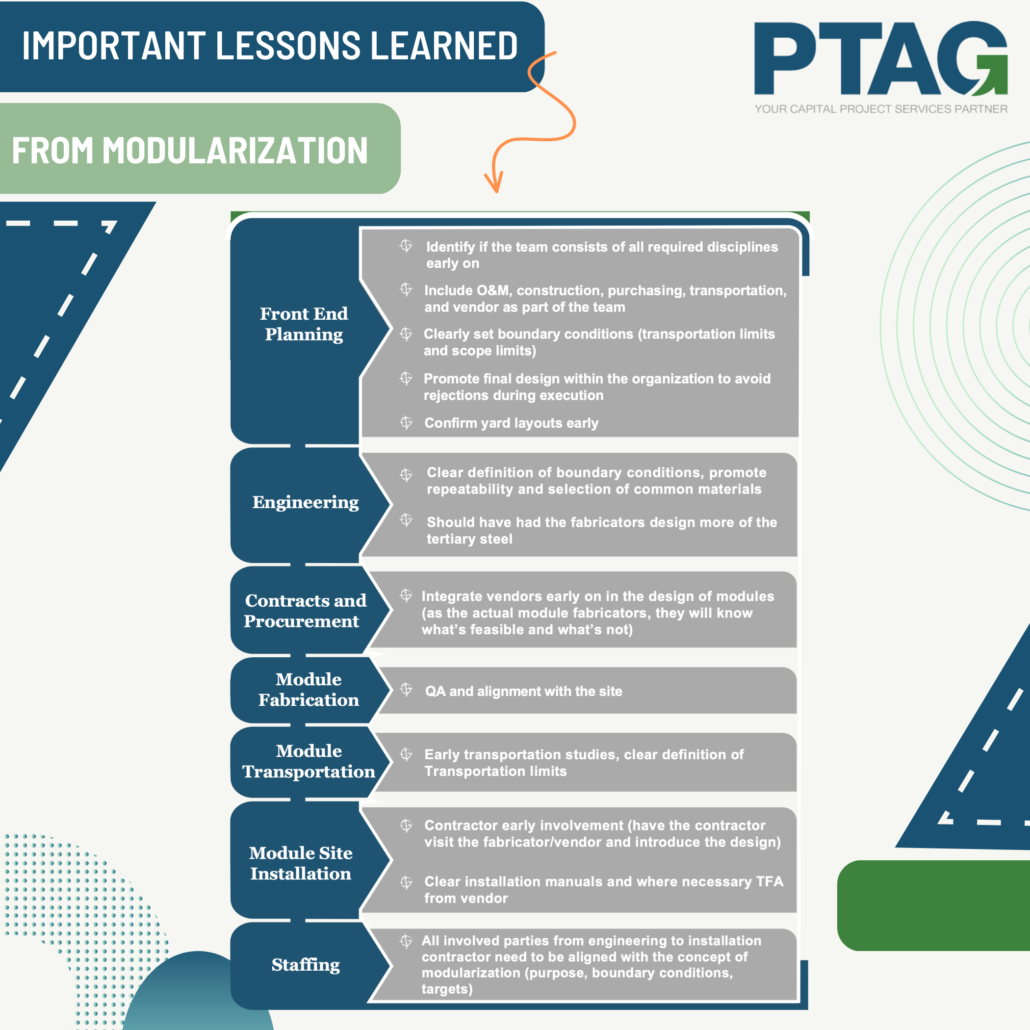
The following figure shows the lessons learned for Front End Planning, Engineering, Contracts and Procurement, Fabrication, Transportation, Site installation, and Staffing.
/wp-content/uploads/2022/10/Best-Practice-2-1.png5951196Elnaz Khaleghi/wp-content/uploads/2024/10/PTAG-Header-Logo-300x50.pngElnaz Khaleghi2023-03-16 11:32:192023-03-16 11:32:20Important Lessons learned from Modularization