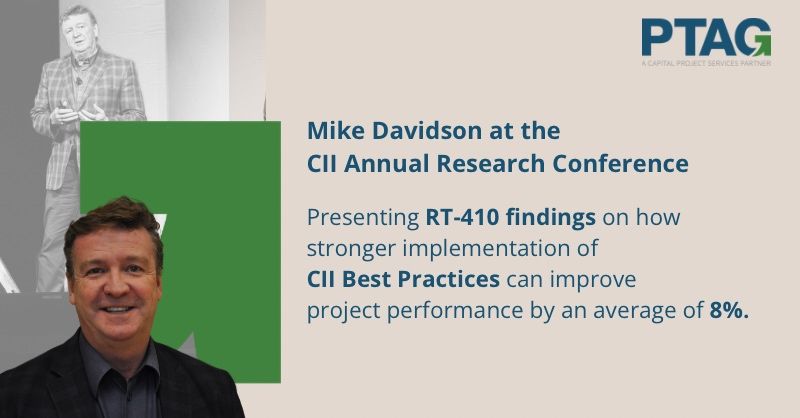
At the 2026 Construction Industry Institute Annual Research Conference, PTAG’s Mike Davidson, presented with Research Team 410 on the connection between CII Best Practice implementation and capital project performance.
The research found that projects with high implementation of CII Best Practices achieve 8% better cost performance than projects with low implementation. This makes implementation maturity a valuable leading indicator, helping owners and contractors identify likely cost outcomes before final results are known.
RT-410 reached this conclusion by benchmarking Best Practice implementation across a growing project dataset and comparing it with actual cost performance. The approach closely reflects PTAG’s benchmarking methodology: measure performance against peers, identify meaningful gaps, and focus improvement efforts where they can have the greatest impact on cost and schedule.
Congratulations to Mike and the RT-410 team on delivering research that owners and contractors can put into practice.
/wp-content/uploads/2026/07/4.jpg13652048Elnaz Khaleghi/wp-content/uploads/2024/10/PTAG-Header-Logo-300x50.pngElnaz Khaleghi2026-07-22 11:18:432026-07-27 11:21:53PTAG’s Mike Davidson Presents CII Research on Best Practice Implementation and Project Performance
Planned shutdowns and turnarounds are critical milestones in industrial operations. When executed well, they optimize performance, minimize downtime, and ensure long-term reliability. But without proper planning, they can lead to unnecessary delays, cost overruns, and operational inefficiencies.
The key question is:
Data-Is your team truly prepared for the next shutdown, or are there gaps in planning that could cause setbacks? Driven PMOs: Not Your Average Office
That’s exactly what Deborah DeGezelle and Mike Davidson explored in the CII Hidden Gems III: Shutdown & Turnaround Success webinar. Drawing from Construction Industry Institute (CII) Research Team 242, they shared valuable insights and tools to help teams enhance readiness, improve coordination, and execute shutdowns with confidence.
The Challenge: Why Some Shutdowns Struggle to Stay on Track
Shutdowns and turnarounds are fast-paced, high-pressure events with many moving parts. While they’re necessary for asset integrity and performance, they come with common challenges:
• Tight schedules – Every extra day offline impacts production and revenue. • Scope expansion – Unplanned work can strain resources. • Stakeholder coordination – Multiple teams must align on execution plans. • Readiness gaps – If teams aren’t fully prepared, inefficiencies arise. • Lack of data-driven decision-making – Without structured planning tools, teams often rely on assumptions rather than measurable insights.
Key Data on Shutdown Performance
• 60% of shutdowns and turnarounds experience cost or schedule deviations. • Projects with structured planning tools achieve greater predictability and cost efficiency. • Organizations using CII’s STAR (Shutdown Turnaround Alignment Review) tool report improved coordination and risk management.
A Proactive Approach: The STAR Tool
One of the most valuable takeaways from the webinar was the STAR Tool (Shutdown Turnaround Alignment Review)—a structured readiness assessment that helps teams proactively identify potential gaps and align on key priorities.
How the STAR Tool Strengthens STO Planning
Evaluates readiness across key areas, including permitting, procurement, commissioning, and startup.
Identifies potential challenges before they impact execution.
Generates action items to enhance preparation and efficiency.
Facilitates alignment between operations, maintenance, and project teams.
Supports data-driven decision-making for more predictable outcomes.
Mike Davidson shared real-world insights from his work with Ontario Power Generation (OPG), where structured planning tools like STAR and PDRI helped transform shutdown execution from reactive to proactive, resulting in improved schedule adherence and cost control.
Key Takeaway
Successful turnarounds don’t just happen—they are built through structured planning and proactive collaboration.
Hidden Gems to Take Home
Tools that Wow: From the BIPP (Best Productivity Practice Implementation Index) to the PDRI (Project Definition Rating Index), CII’s treasure chest is filled with tools to make your life easier and your projects smarter.
The Case for Continuous Improvement: Lessons learned aren’t just an end-of-project afterthought. With tools like the STAR (Shutdown Turnaround Alignment Review), you’re equipped for real-time course corrections.
People Make the Difference: A strong portfolio manager is your ace. RT303 even maps out the skills and authority they need, down to a job description. Now that’s planning.
Strategies for a More Effective Shutdown & Turnaround
Start Early. The best turnarounds begin long before execution day.
Leverage Proven Tools. STAR, PDRI, and PCI provide data-driven insights for better planning.
Align Stakeholders. Coordination between operations, maintenance, construction, and procurement is key.
Manage Scope Effectively. A structured approach helps control changes and minimize surprises.
Take a Risk-Based Approach. Identifying risks early leads to better contingency planning.
Bonus Tip
The STAR Tool helps teams assess readiness objectively—providing a clear picture of where preparation stands and where additional focus is needed.
Common Pitfalls & How to Avoid Them
While every shutdown is unique, there are common challenges that can be mitigated with the right approach:
Ensure readiness is assessed objectively. A structured evaluation helps prevent overly optimistic assumptions.
Engage key stakeholders in planning. Cross-functional alignment ensures all aspects are accounted for.
Take action on identified gaps. Planning is most effective when followed by clear execution strategies.
The STAR Tool isn’t about finding problems—it’s about creating solutions. By using structured assessments, teams can proactively address concerns and enhance efficiency.
Why Partner with PTAG?
Many organizations recognize the importance of structured shutdown planning but struggle with implementation. That’s where PTAG comes in. Our team of shutdown and turnaround experts brings deep industry experience, proven methodologies, and hands-on support to help organizations:
Integrate CII Best Practices – We help implement research-backed strategies to improve shutdown performance.
Optimize Execution Plans – From front-end planning to post-turnaround reviews, we guide teams through every phase.
Enhance Stakeholder Alignment – Our facilitation services ensure seamless coordination across all disciplines.
Improve Cost & Schedule Predictability – With data-driven decision-making and structured assessments, we help reduce risk and enhance efficiency.
Leverage Industry-Leading Tools – We provide expertise in deploying STAR, PDRI, and other critical planning tools.
Our approach isn’t just about avoiding problems—it’s about helping your team execute shutdowns and turnarounds with confidence, efficiency, and long-term success.
How Prepared is Your Team?
If you’re looking to strengthen your shutdown and turnaround processes, PTAG can help integrate best practices for better results.
Reach out to us to learn more about how we can support your team in achieving a more efficient, cost-effective, and predictable turnaround.
Stay tuned for future Hidden Gems webinars, where industry-leading insights for project success will be shared.
Let’s make your next shutdown a success story.
/wp-content/uploads/2024/11/thumb-3.png333873Jess Beltran/wp-content/uploads/2024/10/PTAG-Header-Logo-300x50.pngJess Beltran2025-03-13 12:50:192025-03-13 12:51:28Shutdown & Turnaround Success: Are You Set Up for a Smooth Transition?
Performance culture: the buzzword you’ve probably heard tossed around boardrooms, coffee breaks, and maybe even motivational TED Talks. But here’s the twist – it’s not just jargon; it’s the secret sauce behind organizational success. In the second installment of the CII Hidden Gems Series, Deborah DeGezelle and Mike Davidson took us on a journey through the what, why, and how of cultivating a performance culture that actually delivers results. Here’s the scoop.
Data-Driven PMOs: Not Your Average Office
First up, let’s talk PMOs. That’s Project Management Office for those still deciphering corporate acronyms. A data-driven PMO is like a well-oiled engine that keeps your organization moving. Forget gut feelings and intuition – we’re talking metrics that matter: meaningful, relevant, and targeted to align with strategic goals. Think of it as the GPS guiding your projects through traffic, potholes, and surprise detours.
The key takeaway? Metrics aren’t just numbers; they’re your performance north star. And when resources are tight (aren’t they always?), focusing on impactful metrics is non-negotiable.
Portfolio Management Playbook: Not Just for Sports Fans
Imagine you’re coaching an NFL team. You’ve got your playbook with 75 passing plays, 15 running plays, and one goal: win. Now, swap touchdowns for strategic alignment, and you’ve got the RT303 research team’s playbook for portfolio management.
This gem from CII highlights six core practices to streamline your portfolio, including resource management, risk mitigation, and the pièce de résistance: scalable governance. (Translation: not every project needs the same level of oversight. Save the red tape for where it’s really needed.)
Key message: Treat your portfolio like a team sport. Train your A-Team, develop your B-Team, and make sure everyone’s running the right plays.
Capital Effectiveness vs. Efficiency: Why Not Both?
RT394 introduced us to a concept that might sound like corporate zen: balancing capital effectiveness (doing the right things) with capital efficiency (doing things right). Think Netflix vs. Blockbuster. Netflix stayed nimble, adapting to streaming trends while Blockbuster bet big on brick-and-mortar. Spoiler: one’s still around, and it’s not the popcorn-scented aisles.
The RT394 framework’s interactive tool is a lifesaver for businesses juggling these priorities. With intuitive navigation and practical steps, it bridges the gap between corporate strategy and on-the-ground execution. Efficiency is great, but not when you’re running in the wrong direction.
Hidden Gems to Take Home
Tools that Wow: From the BIPP (Best Productivity Practice Implementation Index) to the PDRI (Project Definition Rating Index), CII’s treasure chest is filled with tools to make your life easier and your projects smarter.
The Case for Continuous Improvement: Lessons learned aren’t just an end-of-project afterthought. With tools like the STAR (Shutdown Turnaround Alignment Review), you’re equipped for real-time course corrections.
People Make the Difference: A strong portfolio manager is your ace. RT303 even maps out the skills and authority they need, down to a job description. Now that’s planning.
Why This Matters (For You)
Whether you’re steering a small project or overseeing an empire, the principles from these hidden gems are universal. Align strategy with execution, focus on data, and never underestimate the power of a well-prepped team. And hey, next time you’re stuck in an elevator with the CEO, you’ll have more to say than “nice weather we’re having.”
What’s Next?
The CII Hidden Gems Series continues in March with “Planning for Start-Up.” If you’ve ever wondered why most organizations flub this critical phase, stay tuned. Until then, remember: a performance culture isn’t just about working hard; it’s about working smart, with purpose, and (most importantly) with results.
Missed the Webinar?
Don’t worry! You can catch the full recording of “How Can a Performance Culture Boost Results?” and see all the insights, examples, and practical tools discussed by Deborah DeGezelle and Mike Davidson.
Click here to watch the video now.
Game on.
/wp-content/uploads/2024/11/thumb-3.png333873Jess Beltran/wp-content/uploads/2024/10/PTAG-Header-Logo-300x50.pngJess Beltran2025-01-17 11:02:092025-01-17 11:02:13How Can a Performance Culture Boost Results? Hidden Gems, Unlocked!
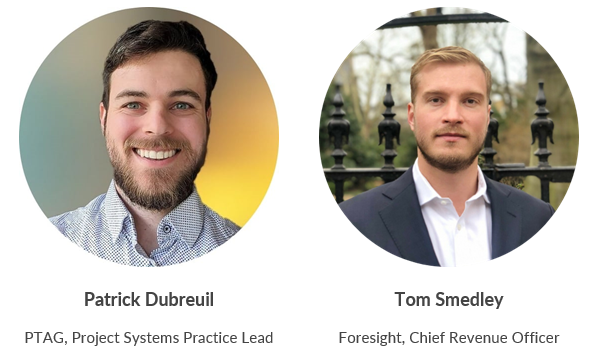
During this webinar hosted by Tom Smedley (Foresight) and Patrick Dubreuil (PTAG), participants explored how AI, machine learning, and natural language processing can revolutionize construction project management. The session, focused on addressing common challenges like delays and cost overruns, was held on April 25, 2024, drawing a diverse audience of industry professionals eager to leverage technology for better outcomes.
PTAG leverages AI tools by blending it with our deep expertise in project controls and project management, ensuring a secure project context-centric approach to handling project complexities. By integrating the benefits of AI with the contextual expertise the PTAG team brings, enhances decision-making through predictive analytics and performance insights. This combination leads to improved project delivery by enhancing schedule adherence and optimizing resource allocation. By focusing on client-specific needs and outcomes, PTAG ensures that tools like Foresight not only support but also drive superior project performance and efficiency. This strategic combination underscores PTAG’s commitment to innovation and excellence in project management.
This is the recap video recording of the webinar, which was originally recorded on April 25, 2024
Stay tuned for future webinars and industry updates from PTAG!
/wp-content/uploads/2024/04/Untitled-design-2024-04-10T103154.815-1.png22504612Elnaz Khaleghi/wp-content/uploads/2024/10/PTAG-Header-Logo-300x50.pngElnaz Khaleghi2024-05-02 13:10:572024-05-02 13:10:57Foresight and PTAG Webinar recap : Accelerate your major construction project delivery with AI – April 25, 2024
See a demo of how AI can help you execute projects faster
If your construction teams are suffering from delays and cost overruns on major projects, there is a solution. By applying AI, machine learning and natural language processing to project schedule data, you can unleash predictive insights about delay risks and work prioritization.
Join Foresight and PTAG on April 25,2024 at 11 am (EST) as we discuss best practices for how AI can improve your planning, execution, and risk recognition.
We’ll demonstrate how unlock the hidden value in your Oracle Primavera P6 and Microsoft Project data, including how to:
· Identify Priorities and Set Action Plans
· Collaborate with Diverse Stakeholders
· Recognize Risks and Bottlenecks
· Learn from Past Projects
· Enhance Schedule Reporting and Visibility
Attendees are eligible for a complimentary AI-enabled schedule health check!
See for yourself how quick and easy it is to overcome the shortcomings of legacy scheduling software.
/wp-content/uploads/2024/04/Untitled-design-2024-04-10T103154.815-1.png22504612Elnaz Khaleghi/wp-content/uploads/2024/10/PTAG-Header-Logo-300x50.pngElnaz Khaleghi2024-04-11 11:42:272024-04-11 11:42:27Best Practices Webinar: Accelerate your Major Construction Project Delivery with AI
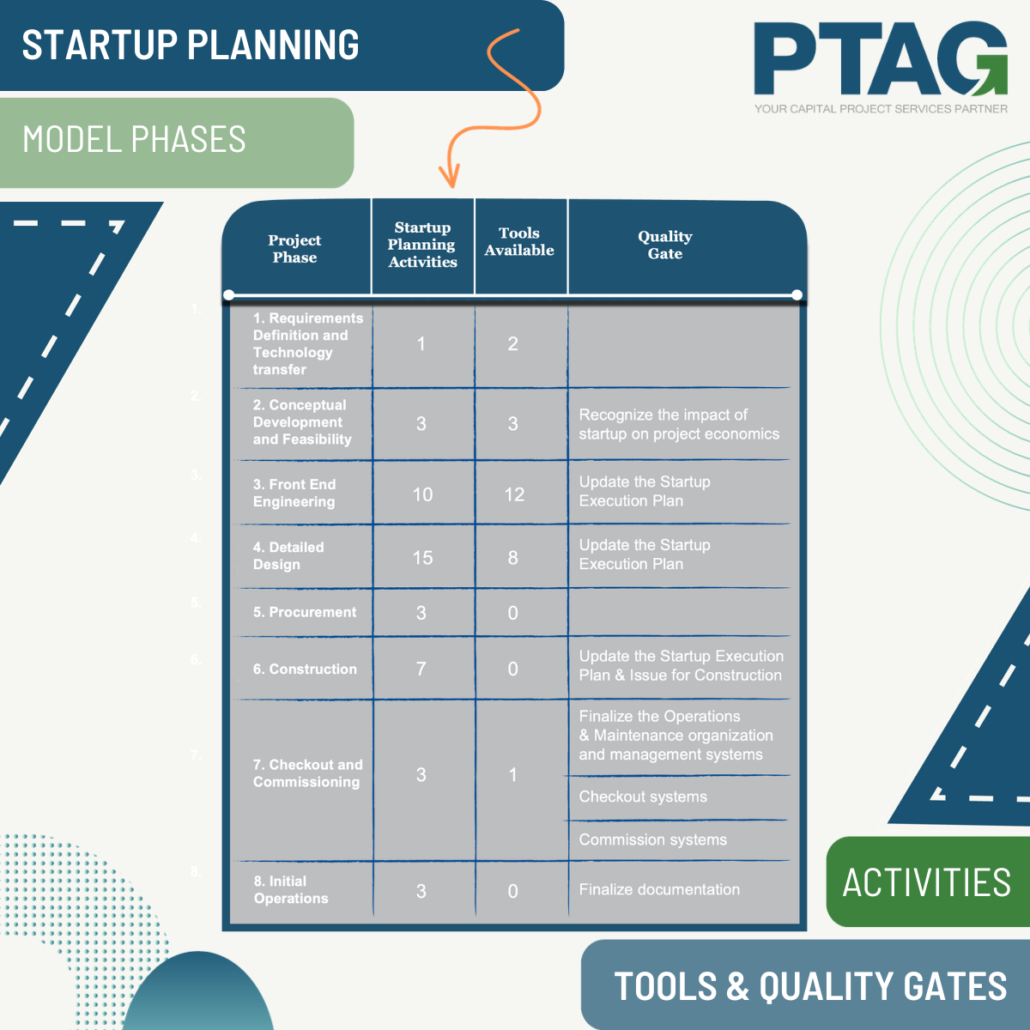
Startup is the transitional phase between plant construction completion and commercial operations, including all the activities that bridge these two phases. Critical steps within Startup include system turnover, checkout of systems, commissioning of systems, introduction of feedstock, and performance testing.
The importance of Startup planning is exemplified by the pressures to increase profits by reducing costs, reductions in owner staff and increases in outsourcing of services, demands for shorter project life-cycle times, and a lack of planning capabilities and supportive tools. These business and project challenges demand increases in organizational efficiency and management effectiveness.
Successful project delivery and commercial operation requires a successful Startup. Research indicates a reasonably strong correlation between Startup success and comprehensive Startup planning.
PTAG provides a Startup Planning Model for Startup activities through all eight project phases:
Requirements Definition and Technology Transfer
Conceptual Development and Feasibility
Front-End Engineering
Detailed Design
Procurement
Construction
Checkout & Commissioning
Initial Operations
/wp-content/uploads/2022/10/Best-Practice-2-1.png5951196Elnaz Khaleghi/wp-content/uploads/2024/10/PTAG-Header-Logo-300x50.pngElnaz Khaleghi2024-01-04 11:05:272024-01-04 11:05:27Planning For Startup
Planning for modularization is the evaluation and determination of offsite construction in the front end planning phase to achieve specific strategic objectives and improve the project outcomes. The process includes developing a business case and execution strategy for large-scale transfer of stick-built construction effort from the job site to fabrication shops or yards.
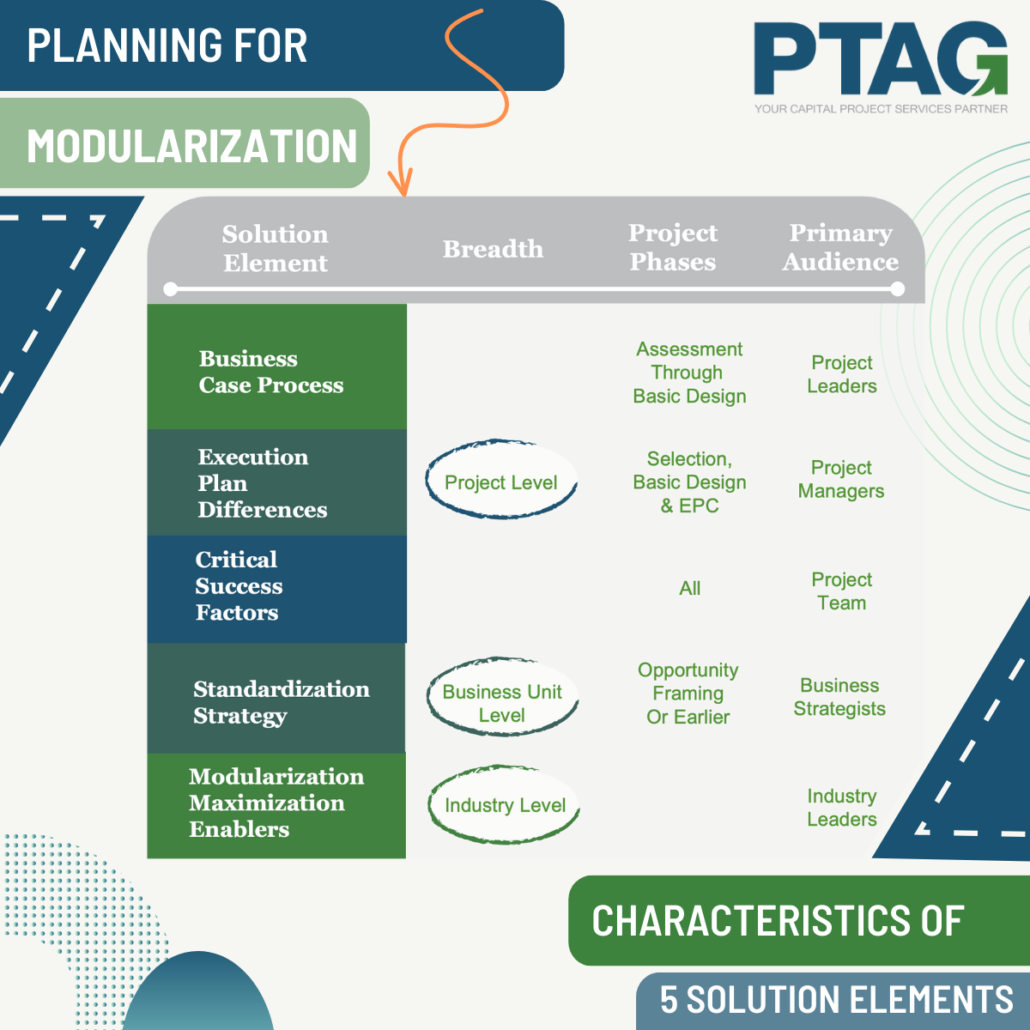
In order to achieve higher, more successful levels of modularization, industry and project leaders should be attentive to the five different elements of the solution, as illustrated in the following picture:
Business case process
Execution plan differences
Critical success factors
Standardization strategy
Modularization maximization enablers
The modularization business case process should be applied at the earliest opportunity. Project teams should consider the modular approach the “default” approach in order to allow the advancement of modularization in the industry
Industry-wide barriers continue to challenge the broad-based achievement of high levels of modularization. There are ten maximization enablers to act as counter-measures to these challenges and to accelerate modularization across the industry.
At PTAG, our industry-specific teams are ready to implement modularization on your project to enhance various aspects of project management, including time, cost, safety, quality, and productivity.
/wp-content/uploads/2022/10/Best-Practice-2-1.png5951196Elnaz Khaleghi/wp-content/uploads/2024/10/PTAG-Header-Logo-300x50.pngElnaz Khaleghi2023-01-31 09:01:252023-01-31 09:01:26Planning For Modularization
Within the construction industry, partnering – an optimal relationship between a customer and supplier – offers many opportunities to improve construction projects’ total quality and cost-effectiveness while developing an atmosphere conducive to innovation, teamwork, trust, and commitment. Partnering can be used to attain total quality management (TQM).
Key Elements of Partnering:
a. Long-Term Relationship
b. Commitment
c. Continuous Improvement
d. Trust
e. Investment
f. Alignment
g. Synergism
h. Shared Risks
i. Mutual Rewards
j. Equity
k. Systemic Relationship
l. Competitive Edge
Benefits of Partnering:
a. Continuous improvement of the quality of services and products b. More effective utilization of resources c. Improved profits (value) for all parties d. Encourages innovation on projects e. Develops long-term teamwork, trust, and commitment f. Allows for continuous planned development of new skills and processes
Major Concerns of Partnering:
a. Protecting proprietary information b. Evaluation/assurance of value received c. Fair sharing of risks by all parties d. Obtaining/maintaining total commitment e. Creates strong dependency on partner f. Limits competitive market strategy g. Integration of differing company cultures
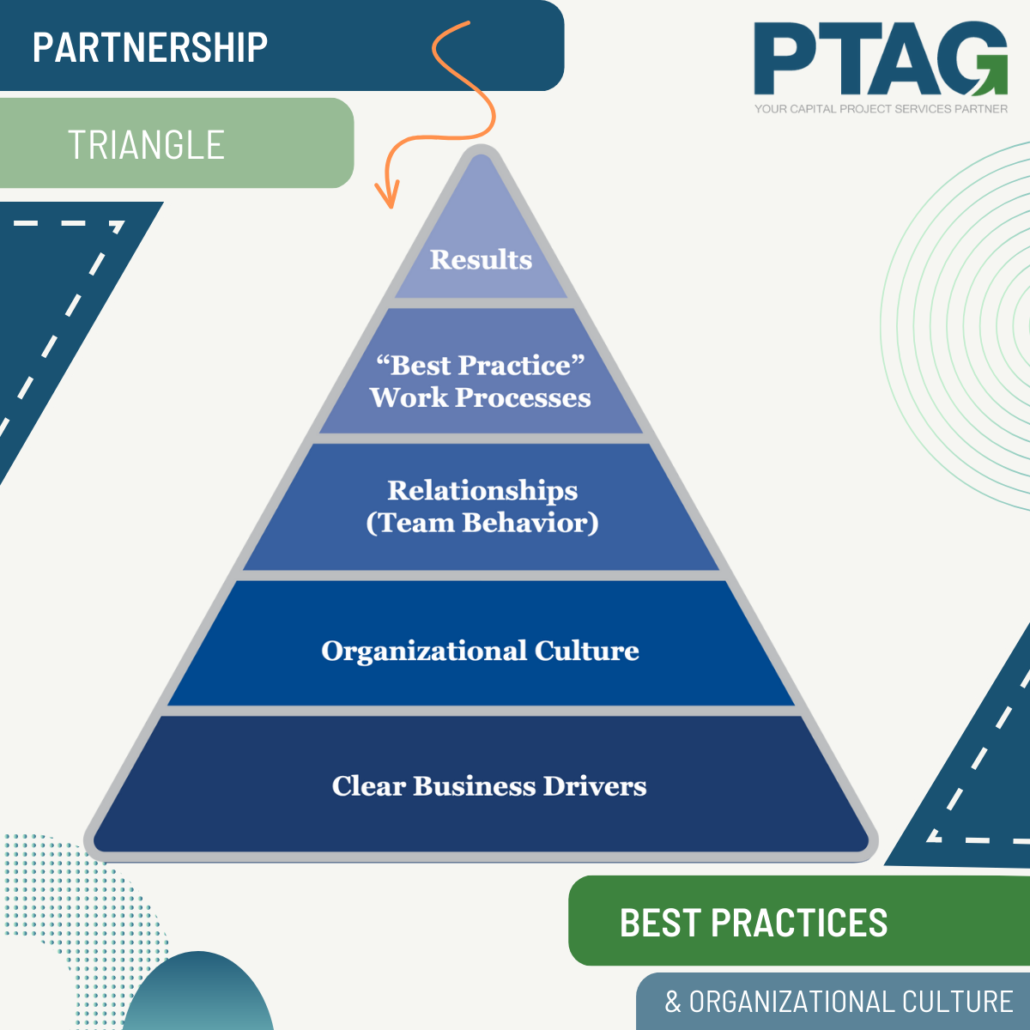
Results, Process, and Relationship Measures
To assess the true benefits of partnering, track and measure performance in a partnering relationship, then compare those results with the same data from before the adoption of partnering. Research suggests using the following measures:
Results: hard measures based on objective analysis of performance relative to quantifiable standards
Process: used to assess the existence and performance of work processes
Relationship: qualitative measures used to assess the health of a partnership or project team, or the perception of its performance by key customers
The partnership triangle shows the criticality of the integration or links of the measures with each other and the business drivers.
PTAG helps you to benefit from partnering by:
a. Continuous improvement of the quality of services and products b. More effective utilization of resources c. Improved profits (value) for all parties d. Encourages innovation on projects e. Develops long-term teamwork, trust, and commitment f. Allows for continuous planned development of new skills and processes
Having a strong partnership makes a tremendous impact on projects.
PTAG has industry-specific teams ready to help you build a united team with a common objective, improving quality, reducing costs, and increasing efficiency.
Partnering is a long-term commitment between two or more organizations as in an alliance or it may be applied to a shorter period of time such as the duration of a project. The purpose of partnering is to achieve specific business objectives by maximizing the effectiveness of each participant’s resources.
Partnering’s bottom line: a construction industry process that strengthens both projects and partners, tightens schedules, safeguards quality, and enhances each partner’s competitive edge.
Partnering requires changing traditional relationships to ones that exist within a shared culture without regard to organizational boundaries. These relationships are based on trust, dedication to common goals, and mutual understanding of individual expectations and values.
Successful partnering involves selecting a qualified partner, establishing a rapport between the two major players in the project, and then expanding the commitment to other key players in the project.
Six key factors in implementing and managing successful partnering relationships are:
Establishing Trust
Getting Top Management’s Support
Establishing Win-Win Objectives
Addressing Internal Barriers
Getting Champion to Direct the Process
Developing Measures, Linked to Objectives
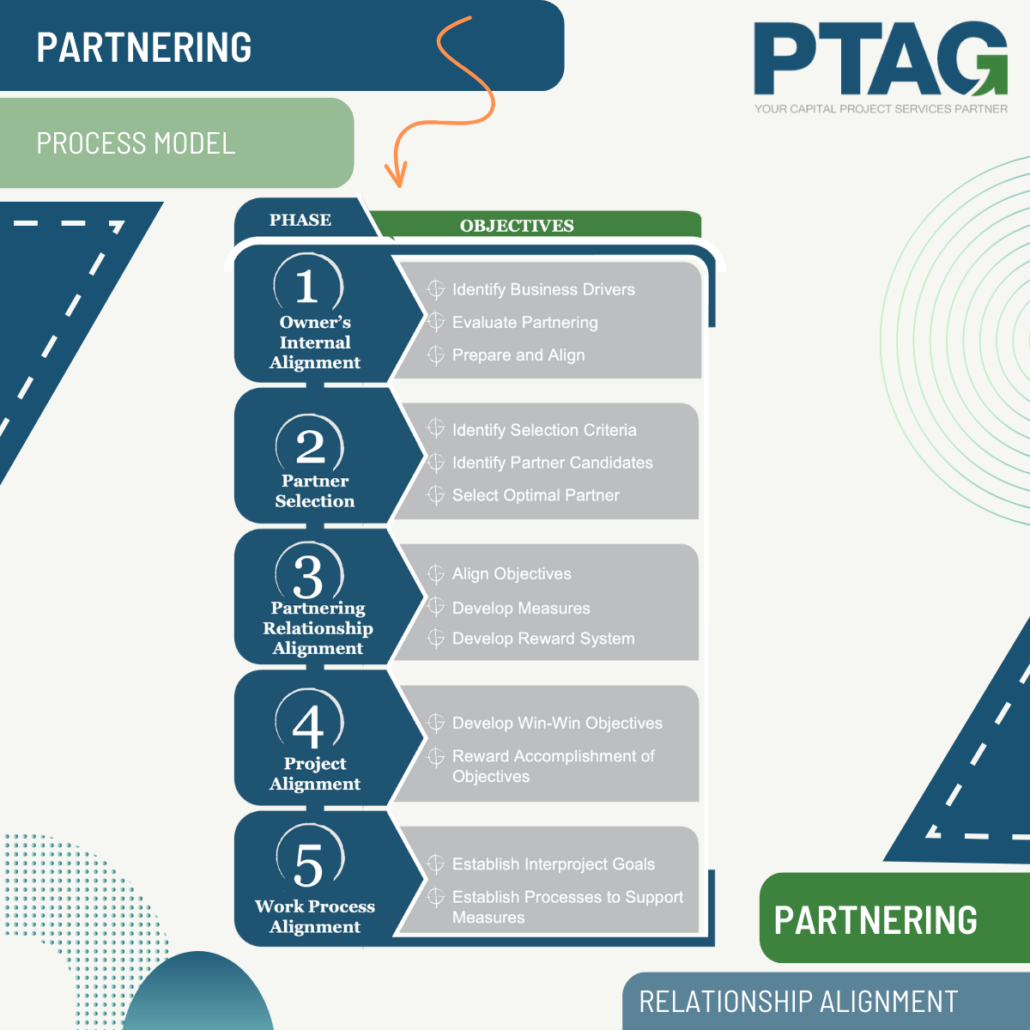
Managing an Effective Partnering Relationship is a Five Phase Process:
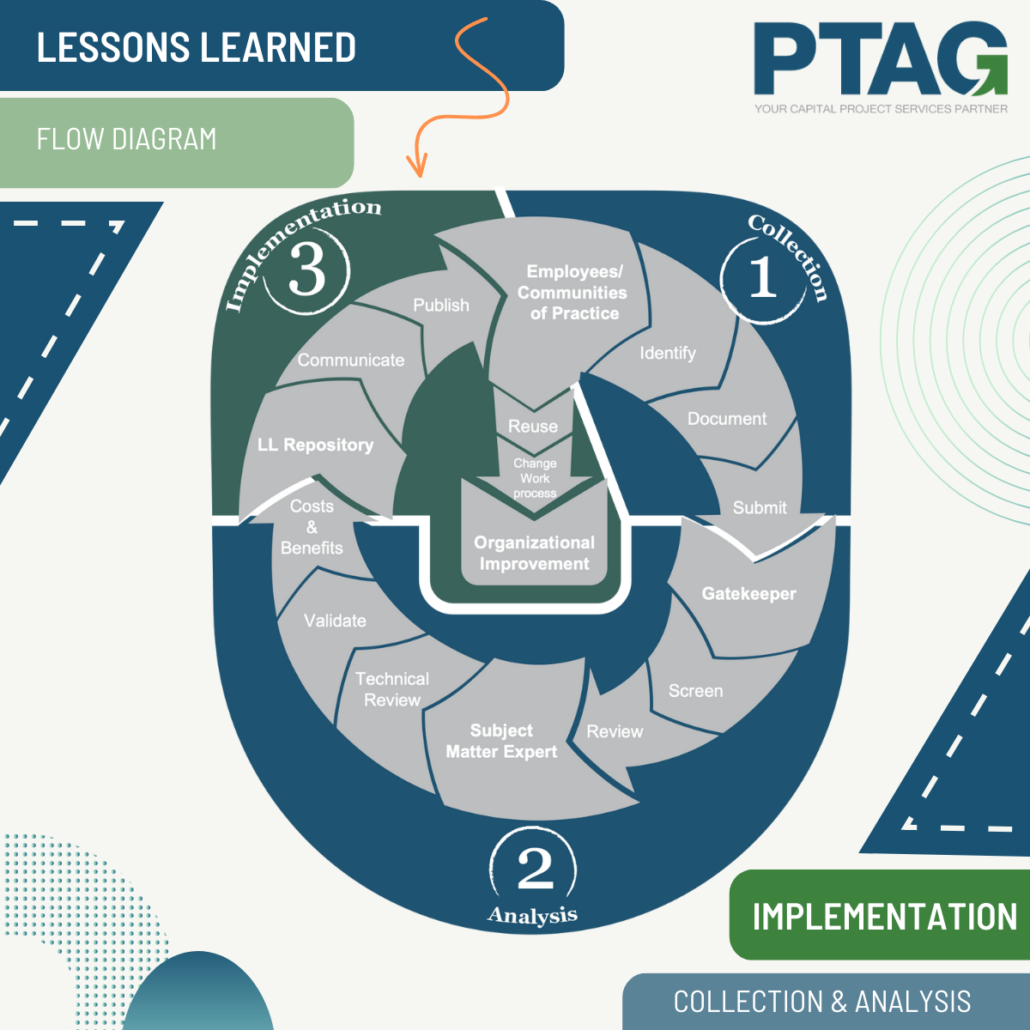
Lessons Learned (LL) is knowledge gained from experience, successful or otherwise, to improve future performance. Each company should develop a Lessons Learned Program (LLP) to promote success and achievement. The Lessons Learned Program involves the people, processes, and tools that support an organization’s collection, analysis, and implementation of validated lessons learned. People possess organizational knowledge. The procedures must be structured to allow people to collect, analyze, and share knowledge easily.
Overall, Lessons Learned Programs are essential to the construction industry. The key to achieving an effective and sustainable Lessons Learned Program is the degree of continuing commitment and leadership from the organization’s top management. Lessons Learned will become even more critical as employees age and retire and turnover increases. Additionally, globalization also increases the need for LLPs to ensure that an organization is able to address critical issues such as culture, language, distance, and diversity.
Every organization should move forward in developing or improving a lessons learned program.
Leadership, top-level and tactical, is the essential prerequisite for the success of these programs.
Organizations should become “teaching” organizations rather than organizations that only collect or learn from the past in an ad hoc or passive manner.
Organizations should adopt an active implementation strategy to ensure that lessons are used.
Although technology is vital in developing and using the Lessons Learned Program, the importance of organizational culture should not be underestimated.
The quality of lessons learned is more important than the quantity of lessons in the database.
Both owners and contractors can benefit from lessons learned programs. Necessarily, the captured lessons learned will be focused on different areas based on the organization’s business needs.
There are three main components to the Lessons Learned Program (LLP):
The collection involves gathering data and information on the experiences of individuals and teams in the organization. Collection can occur at multiple stages of project execution.
Analysis can be performed by a team or a subject matter expert (SME). This step is necessary to ensure the information gathered is relevant, correct, and easily understood.
Implementation can involve changes in practices and procedures or changes in the project execution. Lessons learned should be implemented quickly to ensure they are helpful for the organization.
PTAG has industry-specific teams ready to manage and organize this knowledge to benefit your organization in the form of a reduction of total project cost and/or reduction of project schedule.
/wp-content/uploads/2022/10/Best-Practice-2-1.png5951196Elnaz Khaleghi/wp-content/uploads/2024/10/PTAG-Header-Logo-300x50.pngElnaz Khaleghi2022-11-15 09:52:002022-11-15 13:01:28Lessons Learned Program (LLP)